Independence and loneliness
The GodmotherIndependence and loneliness are brought into sharp alignment in Rachel Elliot’s Christmas-season isolation: the freedom she has spent years protecting remains hers, but it no longer guarantees confidence, pleasure, or companionship. Her experience turns self-sufficiency from an ideal into a question. When she needs comfort, she is unsure how to seek it without feeling that she is admitting defeat.
Freedom and the loss of self-belief
A week before Christmas, Rachel drives through heavy Friday-night traffic toward a luxury hotel near Bristol, where a Christmas party for Mallarmé and McKenzie Cartwright is to take place. In the car, she recognizes that she has, in effect, fallen out of love with herself. Her former certainty has ebbed, and she does not want to continue being herself unless something fundamental changes. The change that repeatedly occupies her mind is having a baby.
That desire unsettles the independence she has carefully cultivated. Rachel has valued the freedom to shape her own life, especially as friends have encountered compromises and responsibilities she could not imagine choosing for herself. Yet the freedom to satisfy personal whims has little comfort to offer when she has lost both her belief in herself and the desire to pursue those whims. Her thought that she may be tired of being selfish does not resolve the conflict: motherhood appears as a possible transformation, but the relentless return of the thought itself makes her feel besieged rather than in control.
Seeking contact, meeting silence
In traffic, Rachel sits alone in the dark and longs for an interruption. She studies the silhouettes in neighboring cars, wondering whether their occupants are returning to company or escaping it, and whether they want solitude or someone near. When a man turns toward her after she has watched him, she gives a small nod, but he turns back to his windscreen without acknowledging it. The brief encounter makes her wish for human contact visible while offering no assurance that contact will be returned.
She switches on Radio 4 and happens upon a discussion of infertility. The accounts range from a consultation with a witch doctor on the Ivory Coast to extreme fantasies and a story of a first child conceived on the evening of a father’s unexpected death, followed later by twins. The testimony intensifies rather than relieves Rachel’s preoccupation; she turns off the radio and tries to call Anita Cavanagh, who has not been returning her messages.
The two friends have not spoken since an unhappy episode in the agency bar. Rachel is torn between supporting Anita and avoiding the feeling that she is intruding. When she calls Giles Cavanagh, he reports that Anita is on a downward swing and that his parents have been brought in to help at home. He appreciates Rachel’s concern and promises to keep her informed, but does not do so. Their estrangement leaves Rachel with concern she cannot easily act on, while her own need for support remains largely unspoken.
Christmas alone, by choice and by concealment
The approach of Christmas makes Rachel’s isolation concrete. The previous year, she had travelled from family rituals in Gerrard’s Cross to New York to spend the holiday with Nathan Kramer. Remembering their days of late mornings, brunches, films, shopping, and returning to his flat, she sees the former life as almost belonging to someone else. This year, her parents are going to Washington to visit Duncan and Mary Beth; Rachel declines their invitation. She has no invitation to join Ian and Clare in Scotland, and does not want the crowds and noise of Clare’s extended family.
Joy Dalton or Naomi Fullerton might have offered company, but neither possibility appeals. Rachel does not want the family-style Christmas at the Fullertons’ French farmhouse, and she has already agreed to visit them at Easter. Asking for Christmas hospitality as well would feel to her like exposing desperation. For the first time in her life, she faces the possibility of spending Christmas alone, despite regarding herself as someone organized enough to prevent such an outcome.
Anita eventually calls, apologizing for talking too much and asking Rachel to speak about herself. Rachel says that she is fine, mentions the traffic, and ends the call because she needs to drive. Her reassurance does not reveal the depth of her isolation. The exchange shows how easily care can be offered in one direction while personal need remains concealed in the other.
The small signs of absence
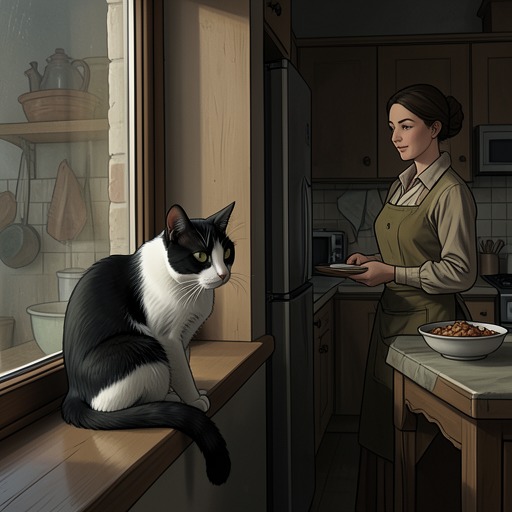
The holiday’s loneliness registers in ordinary interruptions and their absence. Rachel misses the postman, whose occasional doorstep exchanges about the rain or the state of the world had heartened her on bleak mornings. She also misses a cat that had briefly returned after her Bermuda trip and then disappeared again. She had not wanted the animal at first, but its persistent presence had made her attached to it. Two tins of expensive gourmet cat food, bought just before it vanished, remain unused on the windowsill. Their specific, abandoned contents give absence a domestic measure.
Anita’s Christmas card brings a small reprieve. Its picture of an irritated Father Christmas and Anita’s irreverent message cheer Rachel, who wishes her friend were nearby. She recognizes that needing someone to talk to is new and deeply unwelcome, and that independence and isolation are not opposites. The recognition makes the concept’s central tension explicit: solitude may be chosen, but the ability to choose it does not remove the human need for connection.
Rachel also feels guilty and alarmed that she has allowed others to assume she will spend the holiday with her parents in Gerrard’s Cross. She would rather let that impression stand than tell even her oldest friend that she expects to be alone. The concealment is not simply a lack of available company; it is a defense against being pitied. Her response reveals how pride can preserve the appearance of independence at the very moment when that appearance deepens her loneliness.